Landlord Insurance Deductibles: What They Are and When Your Policy Actually Pays
Ask a landlord what their deductible is and most will give you one number.
A thousand.
Twenty-five hundred.
Whatever the renewal notice says.
The number is usually right.
The word “the” is the problem.
Because most landlord policies don’t have one deductible. They have two. Sometimes three or four.
And which one applies to your claim depends entirely on what caused the damage.
That gap between the deductible you remember and the deductible that actually gets applied is where a lot of landlords discover, right in the middle of a claim, that their math was never correct.
Let’s walk through all of them.
First, What a Deductible Actually Is
The deductible is the portion of a covered loss you absorb before the insurer pays anything.
It isn’t a fee.
You never write a check for it.
It comes out of the settlement.
The adjuster prices the repair, subtracts your deductible, and the carrier pays whatever is left. A $12,000 repair against a $2,500 deductible produces a $9,500 payment. You fund the rest yourself.
Two things follow from that, and both matter more than they sound.
The deductible is the carrier’s filter against small claims.
It exists so a $600 problem never reaches an adjuster’s desk.
That’s the design.
It’s also why raising your deductible lowers your premium. You’re volunteering to handle more of the small stuff.
A loss smaller than your deductible isn’t a claim at all.
It’s just a repair bill.
There’s no partial payment. No credit. Nothing carried forward to next time.
This is probably the most misunderstood thing about deductibles, and we’ll come back to it.
The Deductibles on a Typical Landlord Policy
The All-Other-Perils Deductible
This is the one on your declarations page. The one you remember.
It’s a flat dollar figure, commonly $1,000, $2,500, or $5,000 on a rental property.
And it applies to everything the policy covers except whatever has been carved out for separate treatment.
Fire.
Theft.
Vandalism.
A burst pipe.
A tree through the roof on a calm day.
All of those fall under all-other-perils.
The Wind and Hail Deductible
Here’s where the assumptions break.
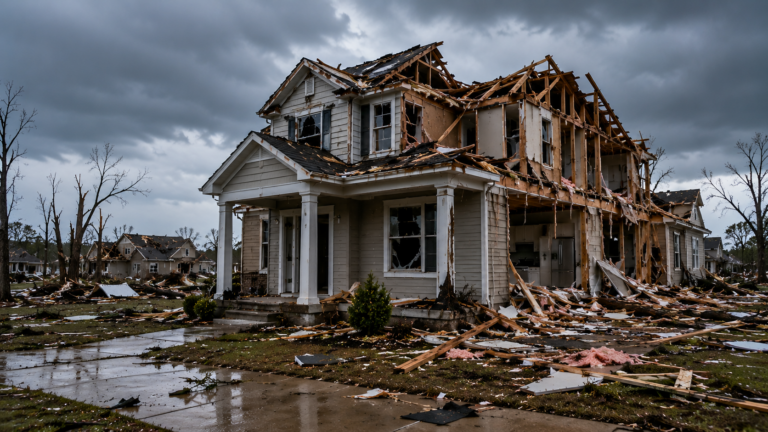
In states where wind and hail losses are common, which covers most of the Great Plains, Texas, the Southeast, and parts of Colorado, the policy almost always carries a separate deductible that applies only when wind or hail caused the loss. The primary deductible doesn’t apply to those claims at all.
And the way it’s calculated changes too.
The wind and hail deductible is usually a percentage of your dwelling coverage limit rather than a flat dollar amount. Common percentages are 1%, 2%, 3%, or 5%.
Work that through.
On a rental insured for $400,000 with a 2% wind and hail deductible, your out-of-pocket on a storm claim is $8,000.
Not the $2,500 printed on your declarations page.
It’s entirely normal, and very common, to carry a $1,000 all-perils deductible and a 2% wind/hail deductible on the same policy. Brodyallenexteriors
Two things make this worse than it first looks.
It scales with your dwelling limit, not your premium.
Every time you raise coverage to keep up with rebuild costs, your storm deductible rises right alongside it.
Nobody sends you a notice about that.
It applies per property.
A landlord with four properties at $400,000 dwelling coverage each, all hit by the same storm, faces that deductible four separate times.
One weather event.
Four separate $8,000 hits.
And this isn’t a niche situation anymore. Carriers across the country have been shifting away from flat $1,000 or $2,500 deductibles toward percentage-based ones in the 1% to 5% range. In coastal zones the percentage can reach 10%. E3insureThe Zebra
Hurricane and Named-Storm Deductibles
In coastal states, this often sits separately again.
And the distinction matters: a hurricane deductible applies only when a hurricane hits, while a windstorm deductible applies to any wind damage, hurricanes included. The Zebra
Florida landlords should look at this carefully.
Florida policies may use a hurricane deductible calculated differently from the standard all-other-perils deductible, and state law governs specific disclosure and hurricane deductible rules. Ackleyflorida
The Loss-of-Rent Waiting Period
This one isn’t measured in dollars.
It’s measured in days.
And most landlords don’t even recognize it as a deductible.
Loss-of-rent coverage doesn’t start paying the moment your tenant moves out.
Policies commonly include a waiting period, often 48 to 72 hours, before payments begin. Some products stretch that to 30 or 60 days, and choosing a longer waiting period reduces the premium. ObieRentlatefee
Practice varies quite a bit here. Some carriers don’t apply a waiting period to loss of rent at all, unlike business interruption policies.
So check yours specifically.
Don’t assume.
What This Actually Means for Your Money
Four practical consequences worth sitting with.
Your real exposure is the largest deductible on the policy, not the smallest.
If you’re setting aside a reserve for a bad year, the wind and hail number is the one to reserve against.
Budgeting to the all-perils figure means you’re underfunded for exactly the loss most likely to be catastrophic.
Raising your deductible is a real lever with a real cost.
Moving from $1,000 to $2,500 measurably reduces your premium.
That’s a sound trade if you can absorb $2,500 without borrowing.
If you can’t, you’ve just bought a cheaper policy and a worse night’s sleep.
Small losses shouldn’t be claimed even when technically they could be.
A $1,400 loss against a $1,000 deductible nets you $400.
And puts a claim on your record.
Claims history follows you at renewal and into the market. That $400 can cost you several times itself over the next three years of pricing.
Multiple properties multiply your exposure. They don’t divide it.
There’s no portfolio-wide cap.
Each policy stands alone. Each deductible applies independently.
And a regional weather event hits all of them at once.
When Your Policy Actually Pays
This is the part that matters most.
And it’s more conditional than the marketing suggests.
Every one of these has to be true.
The Cause Has to Be a Covered Peril
Everything starts here.
If the cause of loss isn’t covered, the deductible never even enters the conversation. There’s nothing to deduct from.
This is also where DP-1 and DP-3 policy forms diverge sharply.
A DP-1 form is named-peril. It covers only what it specifically lists.
A DP-3 form is open-peril. It covers everything except what it specifically excludes.
On a DP-1, if your loss isn’t on the list, you get nothing. No matter how reasonable the claim feels.
Standing exclusions on essentially every landlord policy include:
- flood, which is never covered and requires a separate policy
- earthquake, which needs its own policy or endorsement
- wear and tear and gradual deterioration
- neglected maintenance
- intentional damage by tenants, unless you’ve added vandalism or malicious mischief coverage
The flood one deserves its own mention.
It’s the largest gap on the entire policy, it can’t be endorsed on, and most landlords don’t find out until water is already in the property. We’ve covered what actually covers flood damage on a rental separately.
That third one catches people constantly.
A pipe that bursts is a claim.
A pipe that’s been weeping for two years is maintenance.
The Loss Has to Exceed the Applicable Deductible
Not the deductible you remember.
The one that applies to that specific peril.
Go back to the $400,000 property with the 2% wind and hail deductible. A $6,000 hail repair on that policy produces a payout of zero, because the applicable deductible is $8,000.
The claim is valid.
The coverage is real.
The payment is nothing.
The Property Has to Have Been Occupied
Read your vacancy clause.
Most policies suspend coverage once a property has been vacant for more than 30 or 60 consecutive days. And vacant usually means no tenants and no furniture. If a turnover takes 45 days, you may be uninsured for that entire stretch. Agency Height
This one catches landlords constantly.
Mostly because the vacancy that triggers it is usually routine, not negligent.
You Have to Report It in Time
Carriers require prompt notice.
Late reporting is a defensible reason to deny a claim all by itself, separate from the merits.
And “I was getting quotes first” isn’t a defense.
You Have to Prove the Loss
For property damage, that means photos, contractor estimates, and the adjuster’s scope.
For loss of rent, the bar is higher.
Insurers want proof of both the damage and the resulting income loss, which typically means the lease, rent payment history, photos, inspection reports, and contractor estimates. Castelblanco
Lease agreements, bank statements, and evidence of consistent rent collection are the standard evidence set. Obie
Which leads to an uncomfortable point.
If your tenant pays cash and you’ve kept no records, you’re carrying a coverage you can’t collect on.
The Damage Has to Be Physical
This is a distinction people trip over regularly.
Loss of rent responds to physical damage that makes the unit uninhabitable.
A neighborhood-wide power outage that makes the property unlivable won’t trigger it, because there’s no direct physical damage to your property. Obie
And it doesn’t cover a tenant who simply stops paying.
Coverage engages only after a listed peril renders the unit uninhabitable. It doesn’t pay for tenant payment default or ordinary turnover. Thecreditpeople
That’s rent default insurance.
Different product entirely.
Three Scenarios, Worked Through

Kitchen fire. $18,000 repair. $2,500 all-perils deductible.
Covered peril, well above the deductible, occupied property. The carrier pays $15,500. Loss of rent runs separately for the repair period, subject to whatever waiting period applies.
This is the system working the way it’s supposed to.
Hail damage to the roof. $6,000 repair. Dwelling insured at $400,000 with a 2% wind and hail deductible.
Applicable deductible: $8,000. Payout: nothing.
You fund the entire repair yourself. Your declarations page still says $2,500. It just doesn’t apply to this loss.
This is the single most common source of “my insurance is useless” conversations.
Water damage from a leak under the sink. $4,000 repair. $1,000 deductible.
The peril determines everything here.
Sudden pipe failure: covered, $3,000 payable.
Slow leak that’s been going for months: denied as gradual deterioration, regardless of the deductible.
Same damage. Same repair cost. Opposite outcome.
One more thing worth knowing about that math.
Your deductible comes off the settlement, but what the carrier settles at is a separate question. If your policy pays actual cash value rather than replacement cost, depreciation comes off before your deductible does. And on an older roof, that can leave you at zero on a valid claim.
Here’s what your policy actually pays after depreciation.
What to Check on Your Policy This Week
Pull the declarations page and confirm five things.
- How many deductibles are listed. If you only see one, look again. Separate wind and hail deductibles often appear further down or in an endorsement schedule.
- Whether any of them are percentages. If so, multiply against your current dwelling limit and write down the actual dollar figure.
- Your policy form. DP-1 or DP-3. Named-peril or open-peril. This shapes everything else.
- Your vacancy threshold. Thirty days or sixty. Then be honest about how long your turnovers actually take.
- Your loss-of-rent waiting period and cap. How many days before payment starts, and how many months of coverage you have.
If the wind and hail number surprises you, that’s the finding.
Better to discover it on a Tuesday afternoon than during a claim.
The Bottom Line
Deductibles are the least interesting part of a landlord policy.
They’re also the part most likely to decide whether the policy feels worth owning.
And the failure mode is almost never a landlord choosing the wrong deductible.
It’s a landlord who never learned they had a second one.
Someone who budgeted for $2,500, met an $8,000 percentage deductible after a storm, and concluded the industry had cheated them.
Nobody cheated them.
The number was sitting on the declarations page the whole time.
So pick a deductible you can genuinely absorb without borrowing.
Know your percentage deductible in actual dollars, not as a percentage.
Reserve against the largest one, not the smallest.
And don’t claim the small stuff.
Know What You’d Actually Pay Before You Need To
Whether you own a single rental, a small portfolio, or a short-term rental property, comparing landlord insurance options takes about a minute and could save you from an expensive surprise later.
If you own rental property, reviewing your deductible structure at renewal is one of the easiest ways to find out what you’d really pay out of pocket after a loss.
The right landlord insurance policy should protect the property and the income it produces, without any surprises buried in the fine print.