DP-1 vs DP-3: Which Landlord Policy Do You Actually Have?
Most landlords couldn’t tell you which policy form they’re on.
They know the carrier.
They know the premium.
They know roughly what the deductible is.
But ask whether it’s a DP-1 or a DP-3, and you usually get a pause.
Which is a problem, because that two-character code decides more about your claim than almost anything else on the policy.
It decides which losses get covered at all.
And it decides how much you get paid for the ones that are.
First, What a Dwelling Fire Policy Is
If you rent out a property, you don’t get a homeowners policy.
You get a dwelling fire policy.
Despite the name, these cover a lot more than fire. The name is just a holdover from how the forms were originally written.
There are three of them: DP-1, DP-2, and DP-3.
DP-1 and DP-3 sit at opposite ends of the spectrum. DP-1 is the most basic and limited. DP-3 offers the most comprehensive protection.
DP-2 sits in the middle.
And most landlords are on one of the two extremes, which is why this comparison usually comes down to DP-1 versus DP-3.
The First Difference: What Gets Covered
This is the one that decides whether you have a claim at all.
DP-1 Is a Named-Peril Policy
A DP-1 explicitly lists which perils are covered.
If your loss is on the list, you’re covered.
If it isn’t, you’re not.
There’s no argument to make. No interpretation. The list is the list.
DP-1 typically covers around nine named perils, commonly including fire, lightning, windstorm, hail, explosion, riot or civil commotion, aircraft, vehicles, smoke, and volcanic eruption.
Notice what isn’t there.
Water damage from pipes or appliances isn’t covered. Neither is vandalism.
If the damage comes from anything not on that list, like a burst pipe or a falling object, the DP-1 doesn’t respond.
Worth knowing: some of those perils only apply if extended coverage is shown on your declarations page. Windstorm, hail, explosion, riot, aircraft, vehicles, smoke, and volcanic eruption can be included that way. Vandalism and malicious mischief may be addable too.
Which means two DP-1 policies can cover meaningfully different things.
So the peril list on your own declarations page is the only one that matters.
DP-3 Is an Open-Peril Policy
A DP-3 covers all risks except the ones specifically excluded in the policy documents.
That’s the opposite logic.
Instead of a list of what’s in, you get a list of what’s out. Everything else is covered by default.
Common DP-3 exclusions include nuclear hazards, war, and mold. Others typically include neglect, earthquake, intentional loss, and water damage of certain types.
Flood is always excluded. That needs its own policy, regardless of form.
Why This Matters More Than It Sounds
Here’s the practical difference.
For most rentals, that breadth is the difference between a clean claim and an argument over whether your specific loss made the list.
On a DP-1, the burden is effectively on you. Your loss has to match something on the list.
On a DP-3, the burden shifts to the carrier. They have to point at an exclusion.
That’s a very different conversation to have with an adjuster.
One small technical note that catches people: on a DP-3, open-peril coverage applies to the dwelling and other structures. Personal property coverage stays on a named-peril basis.
So the appliances and furnishings you own inside the unit aren’t necessarily getting the same treatment as the building itself.
The Second Difference: How Much You Get Paid
This is separate from the form. And it’s the part that surprises people most.The Second Difference: How Much You Get Paid
This is separate from the form.
And it’s the part that surprises people most.
Most DP-1 policies settle on an Actual Cash Value basis. ACV means depreciation gets subtracted from your payout, so a ten-year-old roof pays what a ten-year-old roof is worth today. Not what a new roof costs.
DP-2 and DP-3 are replacement cost policies. Same roof, same storm, and the payout reflects what putting a roof back on actually costs.
On anything with real age on it, that gap runs into five figures.
There’s more to it than the headline, though. Replacement cost policies don’t hand you a full check on day one, roof surfacing is often carved out and settled at ACV even on an RCV policy, and the depreciation your carrier holds back isn’t always money you get to recover.
We’ve broken all of that down in ACV vs RCV: why your first claim check is smaller than the estimate.
The Combination Nobody Warns You About

Here’s the part worth slowing down for.
Form and payout basis are two separate things.
But they usually travel together.
The cheapest landlord quotes are frequently a DP-1 on an actual cash value basis. That means fewer covered perils and a smaller payout on the ones that are covered.
Two limitations stacked on top of each other.
That combination is exactly how a low premium turns into a disappointing claim.
And it explains something a lot of landlords wonder about.
When one quote comes in dramatically cheaper than another, the answer is very often the form. One is a broad open-peril policy paying replacement cost. The other is a narrow named-peril policy paying depreciated value. Same house, very different protection.
The lowest-price landlord quote isn’t a better deal. It’s a narrower policy. And the gap shows up at the claim.
Side by Side
| DP-1 (Basic) | DP-2 (Broad) | DP-3 (Special) | |
|---|---|---|---|
| Coverage type | Named peril | Named peril | Open peril |
| Perils covered | ~9 named | ~17–18 named | All except exclusions |
| Dwelling payout | Actual cash value | Replacement cost | Replacement cost |
| Water damage from pipes | Not covered | Typically covered | Typically covered |
| Vandalism | Endorsement only | Typically covered | Typically covered |
| Burden at claim time | You match the list | You match the list | Carrier cites an exclusion |
| Premium | Lowest | Middle | Highest |
| Typical use | Vacant or budget | Middle ground | Most rentals |
Peril counts and inclusions vary by insurer and state. Confirm against your own declarations page.
So How Do You Tell Which One You Have?

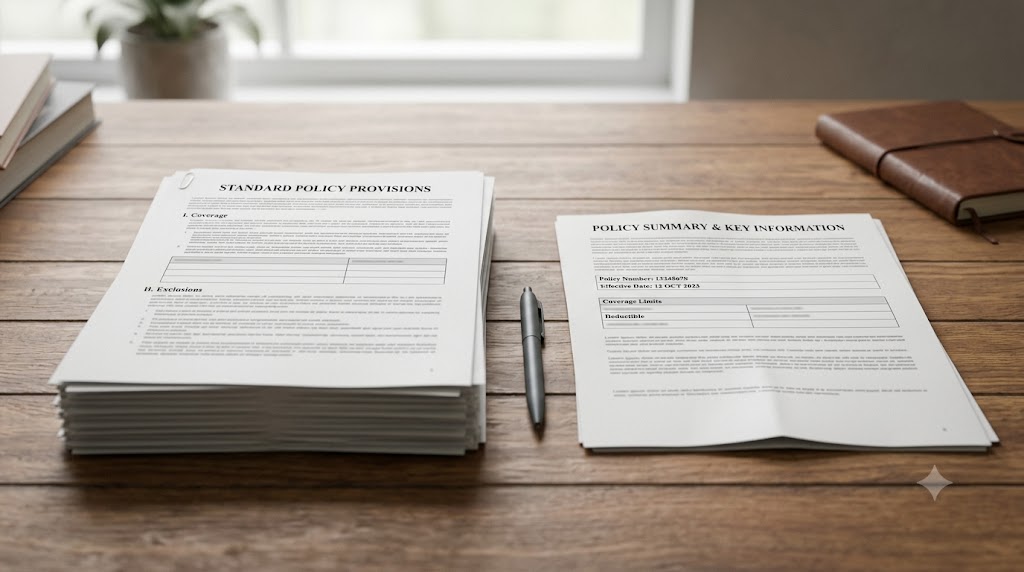
Pull your declarations page.
Look for the form number. It’s usually printed near the top, sometimes as “DP-1,” sometimes as “Dwelling Fire Form 1,” sometimes as a form code like DP 00 01 or DP 00 03.
If you can’t find it, three tells will get you close.
Is there a list of covered perils?
If your policy documents contain a numbered list of what’s covered, you’re on a named-peril form. DP-1 or DP-2.
If instead you find a list of exclusions, you’re on a DP-3.
Does it say ACV or replacement cost?
A cheaper form often comes with actual cash value rather than replacement cost, stacking one limitation on top of another.
If the dwelling settles at actual cash value, that’s a strong DP-1 signal.
Was it the cheapest quote you got?
Not definitive. But it’s a reasonable prior.
If you can’t work it out from the paperwork, call your agent and ask two questions: which form is this, and does the dwelling settle at ACV or replacement cost?
Those two answers tell you almost everything.
When a DP-1 Actually Makes Sense
It isn’t always the wrong choice.
DP-1 is most often used for vacant properties, standalone structures, and budget-conscious landlords who need basic protection.
It can also make sense for older homes where replacement cost coverage isn’t practical.
And these policies are often selected for properties that don’t meet standard homeowners insurance requirements.
So if you own a vacant lot structure, an outbuilding, or a property in poor enough condition that carriers won’t write anything broader, DP-1 is doing a real job.
The mistake isn’t buying a DP-1.
The mistake is buying a DP-1 without knowing that’s what you bought.
When DP-3 Is Worth the Difference
For most rentals, it just is.
DP-3 is considered the most comprehensive landlord insurance option. It’s also the most popular.
Especially if your property:
- has an aging roof or aging systems
- would be expensive to repair at current material prices
- is occupied by long-term tenants
- represents a meaningful share of your net worth
- carries a mortgage you’d still owe after a bad claim
The premium difference is real.
But so is the difference between a depreciated payout and a repair bill.
The Bottom Line
Two things decide what your policy does when something goes wrong.
Which perils it covers.
And how it pays for them.
The form answers the first. The settlement basis answers the second. And they’re usually bundled together in ways nobody explains at quote time.
A DP-1 on ACV is a real policy. It’s just a narrow one that pays depreciated value.
A DP-3 on replacement cost is a broad policy that pays what repairs actually cost.
Both show up as a number on a quote. Only one of them tells you what you’re buying.
So go find your form number. If you already knew it, you’re ahead of most landlords. If you didn’t, that’s the finding.
Know What You’re Actually Buying
Whether you own a single rental or a growing portfolio, comparing landlord insurance takes about a minute and tells you what form and settlement basis you’re being quoted.
If you own rental property, the policy form is worth confirming at your next renewal.
The right landlord insurance policy should pay what repairs actually cost, not what a depreciated roof was worth on the day it blew off.