Accidental Landlords: How This Phenomenon Developed and How It Is Affecting the Rental Market
In 2026, the US housing market is characterized by high real estate prices, unaffordable mortgage rates, and rising property inventory. Under these circumstances, an increasing number of sellers turn into accidental landlords.
An accidental landlord refers to a homeowner who cannot sell their single-family home or apartment at a fair value and decides to delist it and rent it out. This looks like a smart move as it allows you to make consistent rental income, at least until real estate market conditions improve.
But why is this happening now?
With strict closure policies in some states and a massive shift towards remote work at the peak of the Covid-19 pandemic, many relocated to areas that stayed more open and that offered better weather and more affordable living standards. Population growths were specifically pronounced in Florida and Texas. Thinking that work from home might be the new norm, a number of relocators purchased homes in their new cities.
However, now remote working is decreasing, so some people are forced to relocate once again, and they are listing their homes for sale. But in the current buyer’s market, accompanied by a large number of properties sitting on the market and high interest rates, selling is easier said than done.
So, instead of having to sell at a loss, homeowners decide to turn their homes into rental properties and use the income to cover mortgage payments. Needless to say, this is impacting the existing rental market in a major way. With a new influx of rental properties, existing landlords are forced to maintain rental rates at their current levels, preventing sharp rent increases. In other words, rental property owners are feeling stronger competition than ever before, so they have to come up with new ways to remain profitable.
The Impact of the Covid-19 Pandemic on the Real Estate Market
While the phenomenon of accidental landlords is surfacing only now, its roots go back to the global pandemic. Covid-19 hit different states differently, and local authorities introduced various regulations in an attempt to halt the spread of the virus. This led to varying impacts on the local real estate market across the US.
The states of New York, California, and Illinois enforced some of the most severe lockdowns, and unsurprisingly this caused the most significant population declines nationwide. Between 2020 and 2024, 238,000 people moved out of New York, or 1.2% of this total population. Meanwhile, the population decline was 91,000, or 0.2% of all residents, in California and 89,000, or 0.7%, in Illinois.
On the flip side, the biggest population increases happened in Texas, which gained 2.1 million new residents (7% of the state’s total population), and Florida, where the population went up by 1.8 million (8.2%). They were followed by North Carolina (596,000; 5.7%), Georgia (448,000; 4.2%), and Arizona (395,000; 5.2%).
In terms of cities, the highest population shifts were towards Dallas, Fort Worth, Austin, Tampa, Atlanta, and Phoenix.

Starting in 2020, the Sun Belt experienced very positive real estate trends. The main drivers were the population growth (largely young people excited about homeownership) and the low mortgage rates (at about 3%).
But now these trends are reversing as both the labor market and the real estate market are changing.
Why Property Owners Cannot Sell in 2026
In 2026, remote work is no longer the reality for most Americans. Only about 22% of employers work from home, and as little as 16% of companies operate fully remotely. This means that many people need to move once again, as they cannot find good job opportunities in overcrowded states like Florida and Texas.
As more and more homeowners want to sell their homes, the current reality of the real estate market is working against them. According to Zillow, property prices are at their historical high, with the average level reaching $357,445 at the end of January 2026, which marks an year-on-year change of 0.2% only, showing clear signs of a buyer’s market. Meanwhile, the for sale inventory amounts to 1,157,399 (also as of January 31st, 2026) – another indicator of a buyer’s real estate market. Additionally, the 30-year fixed-rate mortgage is high at about 6%.
In other words, it’s a really bad time to sell a house unless you absolutely have to. But for owners who have some flexibility, it usually makes sense to delist their property and list it for rent – whether as a short-term (Airbnb) rental or a long-term (traditional) rental. Thus, accidental landlords are becoming one of the hottest real estate market trends in 2026.
However, as this happens at a scale, particularly in the markets that grew the most during the pandemic, this entry of a large number of units is having major impacts on the rental property market.
How the Rental Market Is Evolving
With rental property ownership on the rise, the supply of new rental listings is growing uncontrollably, while there hasn’t been any major shock to demand, so it’s staying the same. The supply and demand forces are acting in a way that starts pushing rental rates down, negatively affecting the income levels of those landlords that were already in the market.
Let’s take a look at some specific examples of what has been happening to rents in the US. According to data from Apartments.com, with 36,551 apartments for rent, Dallas has experienced a 1.6% drop in the average rental rate from the same time last year. In Tampa, the decline is 3.1%, while it reaches as much as 4.1% in Phoenix. In Austin, the average rent decreased by 5.1%, year-over-year.
These significant declines in rental rates, combined with an increased supply, are putting landlords in a bad situation. However, this is not to say that real estate investors can no longer make money – they just need to think carefully and act smartly.
Choices Left to Landlords Across the US
While accidental landlords are left with little choice, those who decide to invest in real estate properties have more options on the table. Still, because of the growing competition and the shrinking rents in some markets, they have to do their due diligence and invest smartly, with clear market insights.
The rental rates are clearly dropping in the markets that bloomed during the Covid-19 pandemic, but other cities are seeing increasing rents. For instance, the average rent went up 2.4% in New York and 2.9% in Chicago. The increase amounted to 6.6% in San Francisco. So, it makes sense from a new investor’s point of view to look into these markets and analyze how rent rates compare to property prices and other operating expenses. Of course, real estate prices are also on the rise in many of these expanding markets, so you have to take this into account.

Alternatively, if you feel that the traditional rental market is getting oversaturated in your city, you can check out short-term rentals. They remain a viable and profitable real estate investing strategy in many markets across the US.
How to Become an Accidental Landlord: 7 Tips
Despite this somewhat gloomy picture, the good news is that if you decide to keep your property and rent it out (instead of selling it), you can still run a successful rental property business.
Here are a few proven tips that will help you navigate the world of rental property ownership:
- Treat your rental property like a business: Owning a rental property is different from owning a home. Understand that managing a rental property is the same as running a business, and let your decisions be guided by this logic.
- Consider working with a professional property manager: If you’re renting your property to relocate to a different city or state, you might need to hire a property manager. Property management fees are usually worth it, especially for remote investors, as they provide professional services to tenants and properties.
- List your property on multiple platforms: Don’t limit yourself to a single rental website. Market your property on a number of platforms, also considering short-term rental websites such as Airbnb and Vrbo.
- Apply a diligent tenant screening process: Run background checks and credit checks and talk to references to make sure that your tenants will not cause more damage than expected. The last thing you want to deal with as a landlord is property damage or eviction.
- Set the right rental rate: Study the local rental market and set your rent based on rental comps. As a first-time landlord, don’t inflate the rental rate as your property will remain vacant and make no money.
- Maintain your property proactively: Conduct regular property checks and work on small issues right away, before they turn into major, money-draining problems.
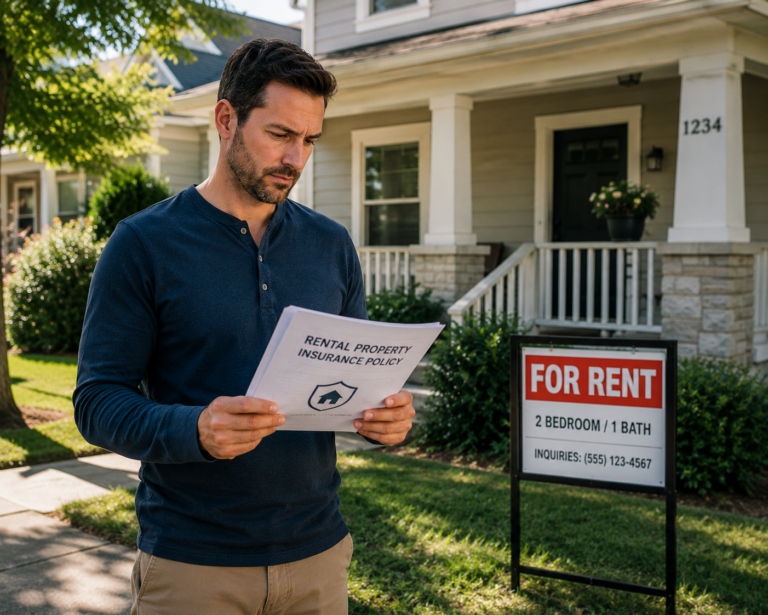
- Get the right insurance to keep your property and income safe: While landlord insurance is not legally required, it is a must for accidental landlords to protect their property, belongings, and rental income. Choose the right rental property insurance from Coverlyn for comprehensive protection against fire, lightning, storm, water damage, vandalism, theft, liability, and loss of rental income.
Conclusion
Becoming an accidental landlord can help you make money from a property you can’t sell. With the tips above, you’ll be a few steps closer to a profitable rental property business.
Contact Coverlyn today to get the right landlord insurance for your property.